The NoSQL Promise — and Where It Breaks Down
In 2015, the answer to "what database should I use?" was almost always MongoDB. Schema flexibility felt like freedom. Document storage felt like it matched how we thought about data. The "schemaless" pitch was compelling for teams that didn't yet know what their data model would look like.
Ten years later, we've built CRM systems for 20+ businesses — from 5-person startups to 200-person enterprise sales teams — and across all of them, we've settled firmly on PostgreSQL as the default choice. Not because NoSQL is bad, but because CRM data has properties that relational databases handle categorically better.
This is the argument we've made, refined, and lived by. Here's the engineering reasoning.
What CRM Data Actually Looks Like
It's worth being precise about what a CRM stores, because the "flexible schema" appeal of MongoDB sounds good until you map it to real CRM entities:
- Contacts — linked to companies, deals, activities, emails, notes, and team members
- Deals — linked to contacts, stages, pipelines, products, tasks, and forecasts
- Activities — calls, emails, meetings, linked to contacts, deals, and users
- Users and teams — with roles, permissions, regions, and quotas
- Audit logs — every state change, who made it, when, from what value to what value
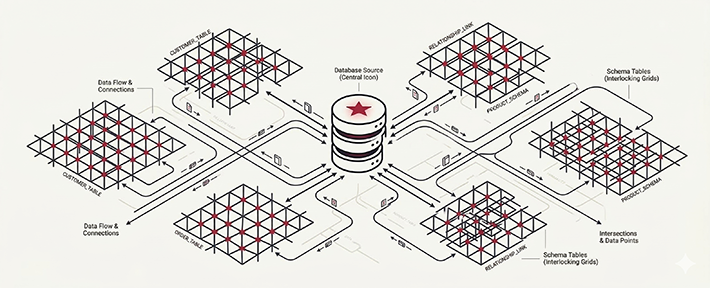
This is deeply relational data. A deal belongs to a contact which belongs to a company which is managed by a user who is part of a team that has a regional quota. These relationships are the value of a CRM — they're what makes the data useful. And relational databases model relationships as a first-class feature, not a workaround.
Five Places PostgreSQL Wins Concretely
1. Referential integrity — data that can't go corrupt
In MongoDB, nothing stops you from deleting a contact that is referenced by 47 open deals. The deals still exist, now pointing to a ghost. You discover this six months later when a report shows revenue attributed to contacts that don't exist.
PostgreSQL foreign key constraints make this impossible. A DELETE on a referenced contact either fails with an error, or cascades (deletes linked deals), or nullifies (sets the contact_id to NULL) — depending on what you've configured. The database enforces the rule. The application doesn't have to remember to.
For enterprise CRMs managing ₹10Cr+ pipelines, data integrity isn't a nice-to-have. Corrupted deal attribution is a finance problem.
2. Complex reporting queries
CRM reporting is inherently multi-table. "Show me the deals closed by each rep this quarter, grouped by source channel, with the average deal size and days-to-close" requires joining deals, users, contacts, activities, and timeline data — and aggregating across all of them.
In PostgreSQL, this is a single SQL query that the query planner optimises automatically. Add indexes on the relevant columns and it runs in milliseconds on 500K rows.
In MongoDB, this same report requires a multi-stage aggregation pipeline that is harder to write, harder to optimise, harder to read in six months, and slower to execute on large datasets. MongoDB's aggregation framework is powerful, but it was designed for document retrieval — not for the relational join-heavy analytics that CRMs generate daily.
3. Transactions — all or nothing
Consider what happens when a deal is won in a CRM: the deal stage changes, the rep's quota counter updates, a commission record is created, an activity log is written, and a notification is sent to the manager. That's five writes that must all succeed together or all fail together.
PostgreSQL transactions (ACID-compliant, true serialisable) make this trivial. Wrap the five writes in a BEGIN/COMMIT block. If anything fails, the entire transaction rolls back. The database never ends up in a half-updated state.
MongoDB added multi-document ACID transactions in version 4.0, but they're slower than PostgreSQL's implementation, rarely used in practice, and carry significant performance overhead on heavily transactional workloads. The CRM write path — constant small, multi-entity updates — is exactly the workload where this matters most.
4. JSONB for genuine flexibility
The "schema flexibility" argument for MongoDB is real but overstated — and PostgreSQL has an answer. The JSONB column type allows you to store arbitrary structured data inside a PostgreSQL column, with full indexing and query support.
In practice, we store the structured core of CRM entities (id, name, owner, stage, value, dates) in properly typed columns with constraints and indexes — and we put genuinely variable attributes in a JSONB column. This gives you the best of both worlds: relational integrity for the data that matters, document flexibility for the data that varies by client.
5. Full-text search, window functions, and CTEs
PostgreSQL ships with capabilities that used to require separate services. Full-text search handles CRM contact/company search adequately up to ~500K rows without Elasticsearch. Window functions let you calculate running totals, rank reps by performance, and compute rolling averages — all in the database, without pulling data into the application layer first. Recursive CTEs model hierarchical data (org charts, deal stage histories) elegantly.
These aren't edge cases. CRM applications use all three heavily. Having them in the database reduces application complexity, reduces the number of round trips, and keeps business logic close to the data.
When NoSQL Is Actually the Right Answer
This isn't a NoSQL hit piece. There are legitimate use cases where a document database wins, even in a CRM context:
- Activity/event logs. A firehose of timestamped events (page views, email opens, API calls) is a natural fit for MongoDB or a time-series database. Write-heavy, append-only, schema varies per event type.
- Session and cache storage. Redis is unambiguously the right tool here. We use it on every CRM project.
- Search indexes. Elasticsearch or Meilisearch for full-text search at 1M+ documents.
- Unstructured document storage. If your CRM needs to store and retrieve arbitrary client documents, files, or rich text, PostgreSQL's JSONB can handle moderate volumes but object storage (S3/R2) is better for the blobs themselves.
In practice, most production CRMs we build use PostgreSQL as the primary database alongside Redis for caching and queuing — and sometimes Elasticsearch for full-text search at scale. MongoDB doesn't appear in our stack for CRM work because PostgreSQL does what we'd use it for, and does it better.
The Real Cost of Schema Flexibility
The strongest argument for MongoDB — "we don't know our schema yet" — is also the most dangerous for CRM specifically. Schema flexibility sounds like freedom early on. By month 6, it becomes a liability:
- The
contactcollection has 14 different shapes of document because the schema evolved without migration discipline - There's no canonical list of what fields exist on a deal — you have to inspect the data
- Reporting queries have to handle missing fields with
$existsguards everywhere - You can't add a NOT NULL constraint to a column that was optional when 30,000 documents were written without it
A client came to us 18 months into a MongoDB-based CRM build. Their contacts collection had 22 distinct document shapes. The reporting module took 3 minutes to run because every aggregation had to handle schema variance. We migrated to PostgreSQL over 6 weeks. Reports now run in under 2 seconds.
PostgreSQL's "rigid" schema is a forcing function for data discipline — and data discipline is what makes a CRM trustworthy over multi-year timescales. Use JSONB for the genuinely variable parts. Let the database enforce the rest.
Closing Recommendation
If you're building or scaling a CRM system, use PostgreSQL. Use Redis alongside it. Consider Elasticsearch if you need full-text search above 500K records. Don't use MongoDB as your primary CRM database unless you have a specific, documented reason that PostgreSQL can't satisfy.
And if you inherited a MongoDB-based CRM that's showing strain — reports are slow, data is inconsistent, queries are increasingly complex — a migration to PostgreSQL is more tractable than it sounds. We've done it twice and it pays back quickly.
Talk to us if you want a second opinion on your current data architecture.