A few months ago, I watched a talented engineer spend forty-five minutes massaging a prompt into an AI chat window.
He was trying to get the model to draft a project specification document with just the right tone, format, and section headers. He would adjust an adjective, hit enter, read through three paragraphs of generic corporate prose, grimace, tweak the instructions, and run it again.
When he finally got something acceptable, he leaned back in his chair, stretched his arms, and sighed with relief. "Look how much time that saved me," he said.
I didn't have the heart to tell him the truth right then: writing that document from scratch, using his own deep knowledge of the project, would have taken twenty minutes. Instead, he had spent nearly an hour acting as a full-time babysitter for an autocomplete engine.
"He felt productive because text was appearing rapidly on a screen. But he had confused typing speed with thinking efficiency."
Across our industry, this scene is repeating itself thousands of times every day. Companies hand out subscriptions to AI tools, tell their staff to become "AI-native," and celebrate when employees paste snippets back and forth between chat windows and text editors.
They think they are building the future of work. What they are actually doing is turning their best thinkers into low-paid copy editors for statistical software.
Millions of Years of Wetware vs. Five Years of Software
To understand why this happens, we have to look at what human intelligence actually is—and what AI actually does.
The human brain is not a search engine, and it is not a text predictor. It is an organ calibrated by millions of years of biological survival. Over hundreds of millennia, our ancestors developed an extraordinary capacity to read nuance, spot danger in incomplete information, judge character, and weigh life-or-death trade-offs in split seconds.
Our minds evolved to handle intent, context, and consequence. When an experienced engineer looks at a system design, they do not simply scan words. They sense where things will break under pressure. They remember the painful post-mortem from three years ago. They understand the office politics between two teams that will make a specific dependency risky. They have taste, instinct, and skin in the game.
Modern AI models, by contrast, are barely a few years old.
They are incredible achievements of mathematics and computing, but at their foundation, they are statistical pattern engines. They look at vast oceans of past human writing and calculate what word is mathematically most likely to come next.
They do not know what a system actually feels like when it crashes at two in the morning. They do not know what it feels like to run out of runway. They do not feel fear, curiosity, or responsibility.
When you ask an AI to write code, summarize research, or draft a memo, it gives you the mathematical average of everything it has ever digested. If you want the average, it is unbeatable on speed. But true breakthrough efficiency has never come from the average. It comes from the rare, sharp insight that only a human mind, shaped by lived experience, can bring to the table. As we explored in our analysis of the Role of Developers in the ChatGPT and Claude Era, long-term technical value lies in system ownership and deep judgment, not in prompt jockeying.
The Trap of the Human-in-the-Middle
The biggest misunderstanding about becoming "AI-native" is the belief that you should sit in the middle of the loop, constantly feeding prompts to a model and reacting to its output.
If your daily workflow looks like this:
- Open a chat window.
- Type an instruction.
- Read the output.
- Correct the mistakes.
- Paste it somewhere else.
...you are not AI-native. You are the conveyor belt in a manual assembly line.
Every time you read synthetic text, your brain has to work harder than if you had written the thought yourself. When you write something from your own head, you already know the mental model behind it. When you read machine-generated text, you have to reverse-engineer what the machine was trying to say, hunt for subtle errors, and verify whether the assumptions hold true.
After two or three hours of this, cognitive fatigue sets in. You stop reading carefully. You start skimming. You let small errors slip through because the language sounds polite and confident.
Before long, you have spent your most valuable mental energy proofreading generic drafts instead of solving the core problems facing your business. Much like The Illusion of Speed in software development, prompt-babysitting feels blistering in the moment while quietly dragging down overall velocity.
What Being Truly "AI-Native" Looks Like
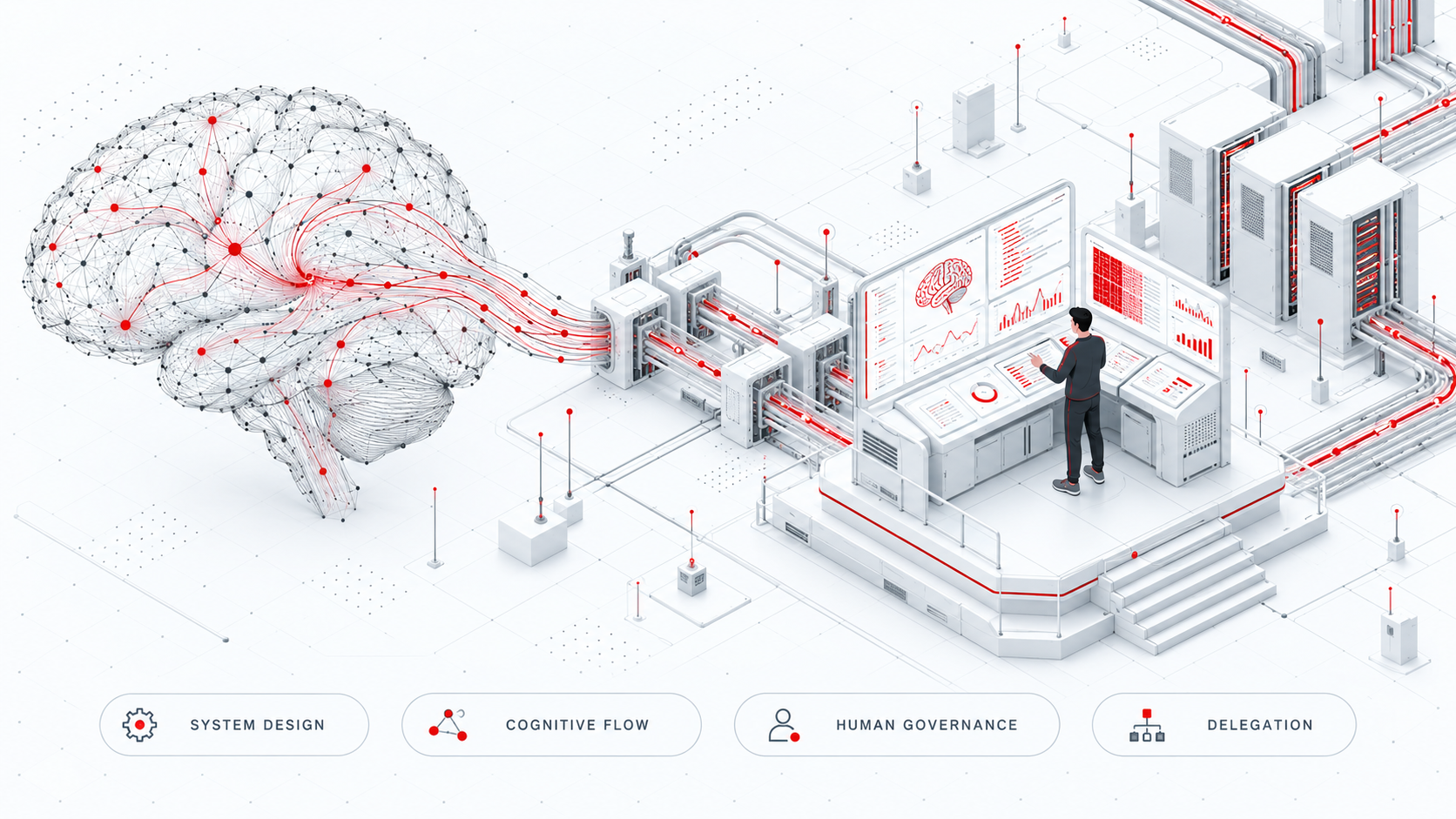
Being AI-native does not mean using AI more often throughout your day. It means designing your work so you don't have to touch the repetitive parts at all.
Real efficiency requires stepping out of the loop.
If a machine can do a task, a human should not be standing over it holding its hand. You should not be writing five prompts a day to format reports, clean data, or generate routine status updates. If those tasks can be done by a model, your job is to build a simple, quiet framework where the model does them automatically in the background—while you do something else entirely.
[Human Mind] ──(Writes Prompt)──► [AI Chat Window] ──(Reads & Fixes)──► [Human Mind]

*Result: Constant interruptions, mental exhaustion, zero deep work.*
[Human Mind] ──(Sets Direction & Rules)──► [Automated System] ──► [Routine Output]
                                                  ▲
                                         [AI executes quietly]

*Result: Machines handle mechanical chores; humans focus entirely on strategy.*
In an AI-native team:
- The machine does the heavy lifting asynchronously: It pulls the data, organizes the notes, runs the initial calculations, and flags anomalies while everyone is asleep.
- The human sets the boundary: You define the standards, the rules of quality, and the non-negotiable requirements before the work begins.
- The human steps in only for judgment calls: You do not edit the wording; you decide whether the project should exist in the first place.
The Machine Predicts; The Human Decides What Matters
There is an old saying in engineering: A computer can give you the answer, but it cannot tell you if you asked the right question.
AI is exceptional at prediction. Feed it enough data, and it can predict customer churn, estimate server load, forecast sales trends, or anticipate which code pattern follows another.
What it cannot do—and what it will not do for the foreseeable future—is tell you what to predict.
- The model can forecast how many users might click a button; only a human founder knows whether that product feature aligns with the company's five-year mission.
- The model can analyze customer support tickets to find the most common complaints; only an experienced leader knows which complaints are noise and which one points to a fatal flaw in the business model.
- The model can churn out twenty marketing angles in five seconds; only someone who deeply understands human nature knows which angle will resonate with a customer's real anxieties.
Predicting an outcome is a mechanical calculation. Deciding which outcome is worth fighting for is an act of human courage, vision, and taste.
When you spend your day asking AI to predict things that don't matter, you are simply moving faster in the wrong direction. True human efficiency is knowing where to point the ship before anyone touches an oar.
How to Reclaim Your Team's Time: A Simple Playbook
If you want to stop babysitting tools and start operating with genuine leverage, here is where to start:
1. Run a "Babysitting Audit"
Look at your calendar and your team's daily habits over the past week. How many hours did people spend chatting with tools, re-prompting outputs, and fixing slightly-off text?
If an engineer or manager is spending more than thirty minutes a day manually prompting an interface for routine deliverables, flag it. That is not productivity; it is hidden overhead.
2. Stop Prompting; Start Systematizing
If you find yourself giving the same type of prompt more than twice a week, stop typing it.
Ask yourself: How can this be triggered without me? Connect the tool directly to the data source. Set up a simple automated trigger that runs the task when an event happens, formats the result, and leaves it in a folder (similar to the automated ingestion flows we discuss in embedding AI into operational CRMs and building production-grade RAG pipelines). If the output isn't reliable enough to run on its own without your constant intervention, it is usually faster to handle the task manually or redesign the process entirely.
3. Move Up the Stack to Intent
Whenever you catch yourself doing mechanical editing, pause and step back. Ask:
- What is the actual goal here?
- What is the risk if this fails?
- What is the one insight about this problem that only someone with my background understands?
That insight is your true job. That is what your company, your clients, and your team are actually paying you for.
The Work That Remains
Technology has always moved routine mechanical tasks away from human hands. The printing press eliminated the scribe. The calculator eliminated the human arithmetic clerk. Compilers eliminated the need to write machine code by hand.
In every case, the people who panicked were the ones who defined their worth by mechanical labor. The people who flourished were the ones who realized that when machines take over the mechanics, human judgment becomes infinitely more valuable.
AI is not going to replace human efficiency, because real efficiency has never been about how many words you can produce in a minute. It has always been about clarity of thought, depth of understanding, and the ability to make high-stakes decisions when the path ahead is uncertain.
Let the machines handle the routine calculations. Set up your systems so they work quietly in the background without needing your constant supervision.
And save your mind—the product of millions of years of evolutionary mastery—for the work that only you can do.