A newly funded Series-A startup celebrated closing a $12M round by making what felt like an inevitable technical decision: abandoning their "messy" monolithic codebase to build an enterprise-grade microservices architecture.
Nine months later, their runway evaporated four months ahead of schedule. Feature velocity dropped to near zero, cloud infrastructure bills surged by 340%, and the engineering team spent half of every sprint resolving cross-boundary data discrepancies.
"The company did not struggle because of product-market fit or poor engineering talent. It almost went under because it adopted the operational overhead of a Fortune 500 company before finding stable unit economics."
Premature distributed architecture is one of the most persistent and expensive traps in early-stage engineering. Here is why the distributed promise breaks down for growing startups—and why the disciplined modular monolith is the architecture that will actually get you to Series B.
The Hidden Tax of Early Distributed Systems
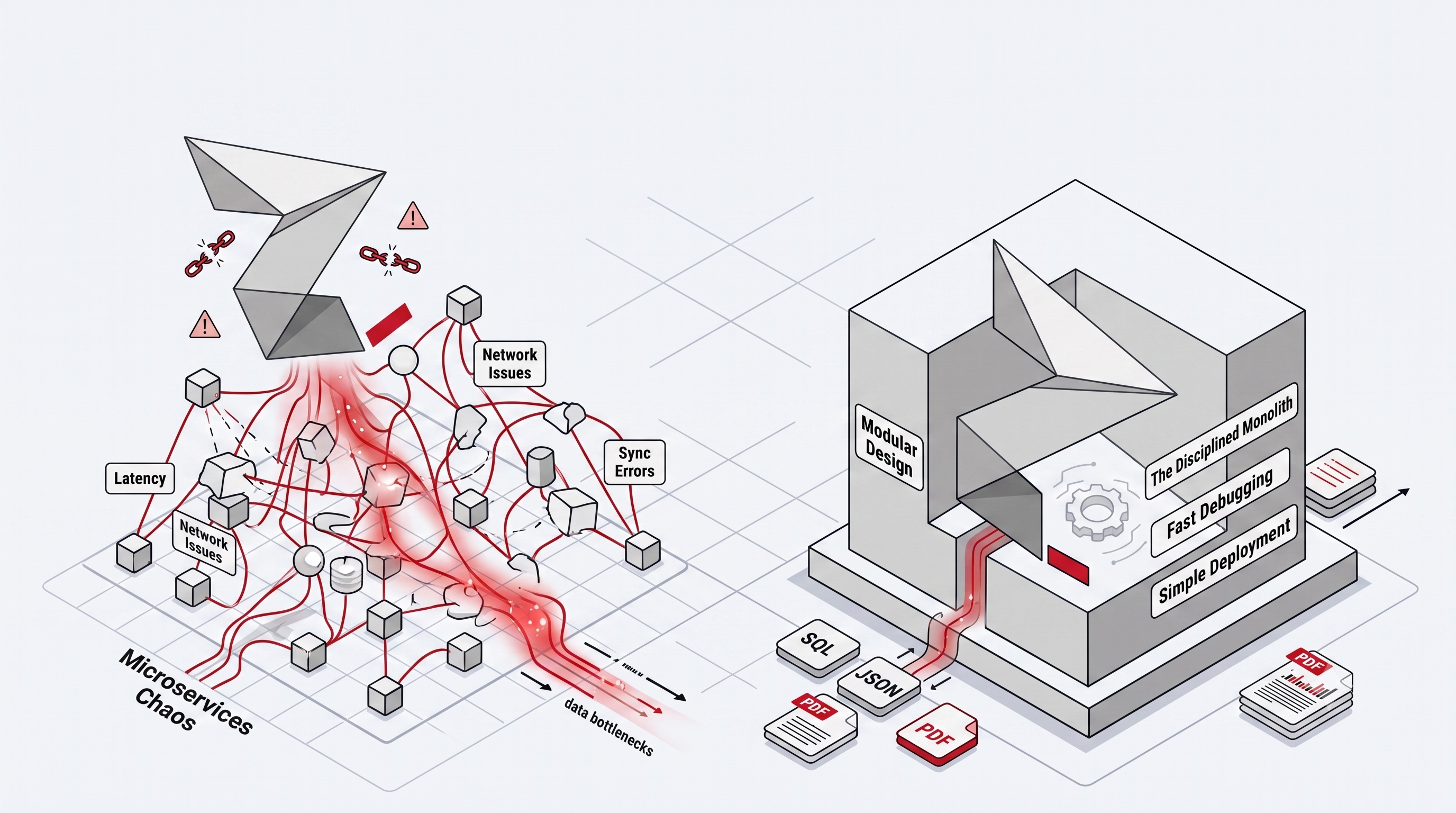
Every single network boundary introduces operational, cognitive, and financial overhead. When a team of eight engineers splits a system into 18 independent services, they do not get loose coupling—they get a distributed monolith.
Instead of fast in-memory function calls, every interaction now requires serialization, network transit, HTTP/gRPC parsing, and potential timeout handling:
       [ Client Request ]
               │
               ▼
      [ API Gateway ]
        │          │
   (Network)   (Network)
        ▼          ▼
   [ Auth Svc ]  [ Billing Svc ] ──(Network)──▶ [ Order Svc ]
        │                                             │
   (Postgres)                                    (Postgres)
When you break apart your stack prematurely, three compounding costs immediately erode your business:
Infra & Observability Tax
High CostRunning distinct services requires container orchestration (Kubernetes/EKS), multi-cluster networking, distributed tracing (OpenTelemetry, Jaeger), centralized log aggregation, and independent CI/CD pipelines.
Distributed Transactions
Integrity RiskIn a monolith, order creation and inventory deduction occur inside a single ACID database transaction. In microservices, this requires sagas, event buses, outbox patterns, and eventual consistency reconciliation.
Cognitive Debugging Drag
Velocity LossA simple bug that previously took 5 minutes with a debugger breakpoint in a single process now requires correlating trace IDs across four repositories, inspecting network timeouts, and replicating async state failures.
Monolith vs. Microservices at Series A
When evaluate technical choices at the early-to-growth stage, every architecture should be measured against business velocity and operational risk:
| Metric / Dimension | Distributed Microservices | Disciplined Monolith |
|---|---|---|
| Deploy Time & Coordination | Multi-repo sync, dependency version hell, cascade deployment order | Advantage Single-command deployment via uniform, deterministic CI/CD |
| Local Development Setup | 15+ Docker containers, high RAM consumption, fragile local mocks | Advantagedocker compose up or a
single runtime process in 5 seconds |
| Data Integrity | Eventual consistency, custom reconciliation cron jobs, data drift | Advantage Native ACID transactions, foreign keys, zero cross-service drift |
| Infra & Observability Cost | High (Managed Kubernetes, APM telemetry, cross-AZ network egress fees) | Advantage Minimal (Single PaaS instance or basic managed cluster) |
| Refactoring Ease | High friction (Requires multi-team API contract migrations & deprecations) | Advantage Fast (Language-native compiler checks, IDE refactoring & static type safety) |
The Alternative: The Disciplined Modular Monolith
Rejecting microservices does not mean accepting a tangled, untyped spaghetti codebase. The sustainable choice for early-to-growth stage startups is the Modular Monolith—a single deployable unit governed by strict internal domain boundaries.
Here is the three-pillar blueprint we use to keep monolithic codebases robust, clean, and blazingly fast:
Enforce Hard Module Boundaries
Group code by domain boundaries, not by horizontal technical layers (no generic
controllers/ or models/ folders). An orders module must expose an explicit public
interface (API/facade) to the rest of the application. Internal database models and helper utilities remain
strictly private to that domain.
Ban Direct Cross-Domain Database Joins
Allowing the billing logic to execute raw SQL joins directly against internal orders tables creates the exact coupling that ruins monoliths over time. Access across boundaries must occur exclusively through designated module contracts or internal in-memory event dispatchers.
If module Billing needs customer order data, call
OrdersService.getOrderSummary(orderId) via TypeScript interface. Do not run
SELECT * FROM orders JOIN billing... across bounded contexts.
Use Automated Boundary Linting
Do not rely on developer discipline alone. Use architectural fitness functions and tooling (such as eslint-plugin-boundaries in Node/TypeScript, ArchUnit in the JVM ecosystem, or Go package internal visibility) to automatically fail CI builds whenever an engineer imports internal classes across module lines.
When Should You Actually Break Apart?
Microservices are not inherently evil—they are an organizational scaling tool, not a performance silver bullet. Splitting a service out of your monolith makes sense only when you hit one of three concrete thresholds:
Contrasting Hardware Demands
A CPU-heavy AI vector embedding pipeline, real-time audio transcription, or video transcoding job starves the main HTTP web application thread pool.
Organizational Friction
You scale past 50–80 engineers across distinct business divisions where deployment coordination delays outweigh the operational tax of network boundaries.
Specialized Security Enclaves
Strict compliance mandates (e.g., PCI-DSS cardholder vault, HIPAA patient record encryption) require completely isolating sensitive payment or health data.
The Bottom Line: Survive to Series B First
Until those operational pressures physically exist in your business, high-performing startups should aggressively leverage the raw development velocity, trivial local debugging, ACID consistency, and single-click rollbacks of a well-architected monolith.
Architecture should serve your business runway—not tech conference vanity. Build your product, validate your unit economics, and survive to Series B first.