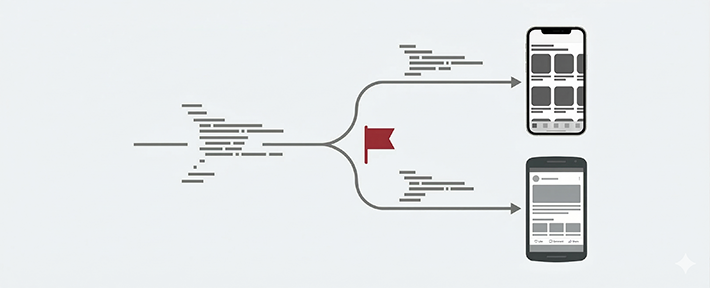
The Question That Won't Go Away
Every client who comes to us for a mobile app asks the same question within the first 20 minutes: "Should we go with React Native or Flutter?" It's the right question to ask. The answer shapes hiring, development speed, long-term maintenance, and what's possible when you need a platform-specific feature in year two.
We've shipped apps in both frameworks — 11 React Native projects and 6 Flutter projects across the last four years. This comparison is based on that experience, not benchmarks from frameworks' own marketing sites.
The short answer: both are production-ready in 2025 and neither is a clearly wrong choice. The right one depends on four factors specific to your situation, which we'll walk through below.
Where They Stand in 2025
The competitive landscape has shifted meaningfully since 2022. React Native's new architecture (Fabric + JSI) — which was in beta for years — is now stable and the default in new projects. The bridge-based performance complaints that defined React Native's reputation from 2018–2022 are largely moot for new apps built on the new arch.
Flutter, meanwhile, has matured from a Google experiment into a genuinely polished framework with a deeply committed community. Dart as a language is no longer a barrier — it's approachable for anyone who knows TypeScript or Kotlin. Flutter 3.x's Impeller rendering engine has resolved the GPU compilation jank that plagued Android builds in the past.
Both frameworks now ship apps that feel native to a careful user. The differentiation is now about ecosystem, team fit, and architectural trade-offs — not raw capability.
The Four Deciding Factors
1. Your team's existing skills
This is the most underrated factor and the one that most influences actual delivery speed. React Native is JavaScript/TypeScript — if your team already builds web frontends in React, the learning curve is a matter of days, not months. State management patterns (Redux, Zustand, React Query), tooling (ESLint, Prettier, Vite), and mental models transfer directly.
Flutter uses Dart. Dart is a well-designed language — genuinely pleasant to write — but it's a cold start for a web or Node.js team. If nobody on the team knows Dart, factor in 4–6 weeks of productive ramp-up time before you're shipping at pace.
Give this factor the most weight if you have a fixed deadline or a small team that can't afford parallel learning and delivery.
2. UI customisation requirements
Flutter's biggest genuine technical advantage is its rendering model. Flutter draws every pixel itself using Skia/Impeller — it doesn't use native UI components. This means pixel-perfect consistency across iOS and Android, beautiful custom animations, and complete control over every visual element. Building a complex custom chart, a gesture-heavy map interface, or a highly branded design system? Flutter is the better tool.
React Native renders actual native components — an iOS button looks like an iOS button, an Android button looks like an Android button. For many apps, this is a feature not a bug: you get the platform's native feel for free, accessibility is handled by the OS, and you don't have to fight the framework to respect platform conventions.
3. Third-party integrations
This is where React Native's JavaScript roots pay off most clearly. Any JavaScript library works, including web-first SDKs that expose a REST API. The npm ecosystem is simply larger than pub.dev (Flutter's package registry), and Indian-specific integrations — Razorpay, Juspay, Aadhaar verification, UPI deep links — all have mature React Native packages maintained by their respective companies.
Flutter's ecosystem has grown dramatically, and for the major global SDKs (Firebase, Maps, analytics) you'll find maintained packages. But for niche Indian payment or compliance SDKs, React Native packages are more likely to exist, be more recently updated, and have more community examples.
4. Long-term platform feature requirements
The more you need deep platform-native capabilities — background processing, widgets, Siri/Google Assistant shortcuts, CarPlay, WatchOS, live activities — the more the calculus changes. React Native's bridge to native code is direct and the patterns are well-documented. Flutter can do most of this too (especially with platform channels), but the recipes are thinner and you'll spend more time reading source code than Stack Overflow answers.
| Factor | React Native | Flutter |
|---|---|---|
| Language | TypeScript / JS | Dart |
| Team ramp-up (JS team) | Days | 4–6 weeks |
| UI rendering | Native components | Custom renderer |
| Pixel-perfect custom UI | Good | Excellent |
| Indian SDK support | Excellent | Good |
| npm / pub.dev packages | ~2.5M npm | ~35K pub.dev |
| Performance (new arch) | Excellent | Excellent |
| Platform-native features | Better recipes | Growing |
| Web/Desktop target | Experimental | More mature |
| Hiring pool (India) | Very large | Growing fast |
| Company backing | Meta |
Performance: The Actual State in 2025
The old narrative — "Flutter is faster than React Native" — was broadly true from 2019–2022 and is now significantly more nuanced. With React Native's new architecture fully stable, the performance gap for typical business apps (lists, forms, maps, media playback) has narrowed to the point of being imperceptible to users.
Where Flutter genuinely still wins on performance is in animation-heavy UIs with 60fps+ requirements and in apps with very complex custom drawing. If your app is primarily data-driven (CRM, delivery tracking, marketplace) the frameworks are equivalent in practice.
Where React Native can still feel worse: heavy use of old-architecture third-party libraries that haven't migrated to the new arch. Vet your key dependencies before committing.
We built Vahan Mitra — a fleet management app with real-time GPS, offline sync, and heavy list views — in React Native. On a mid-range ₹15,000 Android device, scroll performance is indistinguishable from native. The new arch made this possible.
Our Recommendation Framework
After building 17 cross-platform apps, here's the decision tree we use internally:
- Choose React Native if: your team knows JavaScript/TypeScript, you need Indian payment/compliance SDK integration, you have a deadline under 4 months, or your app is primarily data-driven with standard UI patterns.
- Choose Flutter if: you're starting with a team that doesn't know either framework anyway (Dart is worth learning from scratch), your app requires a highly custom or branded design system, you plan to target web and desktop alongside mobile, or you're building games or animation-heavy experiences.
- Either works for: e-commerce apps, delivery tracking, booking systems, CRM companion apps, dashboards, and any standard business application with conventional navigation patterns.
When we onboard a new mobile project with no strong prior constraints, we default to React Native with TypeScript and Expo. Expo's managed workflow handles 90% of native configuration automatically, the new arch is stable, and the JavaScript ecosystem advantage is real. We switch to Flutter when the specific requirements above point to it.
What to Ignore
A few things that come up in every React Native vs Flutter debate that are either irrelevant or overblown in 2025:
- "Flutter will be abandoned by Google." This comes up every year. Flutter has 160K+ GitHub stars, is used internally by Google products (including Google Pay), and has a large independent contributor base. The same concern was raised about Dart in 2018.
- "React Native is dead." Meta rebuilt the entire architecture and open-sourced the result. The new architecture is production-ready at Meta scale. React Native is not going away.
- The JavaScript/Dart language debate. Both are good. Neither will be a meaningful bottleneck for a standard business app. Pick based on team fit, not language preference.
If you want a second opinion on which framework fits your specific product, tell us what you're building — we'll give you a straight answer.