Why Backend Choice Matters More Than Frontend for E-Commerce
When someone builds an online store, the first 90% of the budget goes to design, product photography, and the storefront. The backend is an afterthought — until the first sale day, when 5,000 people hit the site simultaneously and the checkout page starts returning 503 errors.
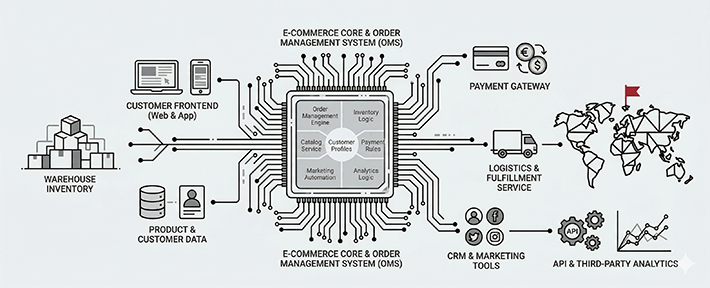
The backend is your store's spine. It handles inventory updates, payment gateway calls, order processing, search queries, and real-time stock checks — all at the same time, under load. Choosing the wrong one doesn't just slow you down; it costs you sales at the worst possible moment.
This guide cuts through the framework wars and gives you a practical decision framework based on what we've actually built and maintained for Indian e-commerce businesses.
Founders and CTOs choosing a backend for a new store, or teams migrating off a platform like Shopify/WooCommerce onto a custom solution. We assume you need custom logic — if off-the-shelf works, use it.
The Four Real Contenders
Ignore the framework rankings on Reddit. In production e-commerce at the ₹10L–₹10Cr revenue range, the real decision is almost always between four options: Node.js (Express/Fastify), Python (Django/FastAPI), Go, and PHP (Laravel). Here's what each actually gives you.
Node.js — the default for a reason
Node.js has become the default choice for e-commerce backends built by product teams in the last five years, and it earns that position. The event-driven, non-blocking I/O model handles a high volume of concurrent connections with a relatively small server footprint. For an e-commerce store — which has a lot of short-lived operations (check stock, validate session, log event) — this is exactly the right model.
The ecosystem is deep: Stripe, Razorpay, Shiprocket, and every Indian logistics API has a Node SDK maintained by the provider. The hiring pool is the widest. And Fastify in particular hits very respectable throughput numbers without the overhead of a full framework.
Best for: Mid-to-large catalogues, teams with frontend JavaScript experience, stores requiring real-time features (live stock, WebSocket notifications).
Django (Python) — best ORM, best admin panel
Django's killer feature for e-commerce is its ORM and its admin panel. The Django admin alone — which gives you a full CRUD interface over your database models in about 20 lines of code — saves weeks of internal tool development for operations teams.
For businesses where the team managing inventory, orders, and customer accounts is non-technical, this matters enormously. Django's ORM also enforces data discipline; it's harder to write accidental N+1 queries than in raw SQL. FastAPI (also Python) offers similar throughput to Node.js but with stronger type safety — a better choice if you're also building ML or AI features alongside the store.
Best for: Businesses with complex back-office requirements, teams already using Python for data/AI work, multi-vendor marketplaces with complex commission rules.
Go — when you need raw throughput
Go is the right answer to a specific problem: you have extreme, predictable traffic spikes (flash sales, IPO-day type events) and you need to squeeze maximum requests per second out of minimum infrastructure spend. Go's compiled binaries handle concurrency with goroutines at a level that no interpreted language matches, and the memory footprint per request is a fraction of Node or Python.
The tradeoff is real: Go has a smaller ecosystem, takes longer to write business logic in, and the hiring pool in India is significantly smaller. We'd recommend Go for the payment processing or inventory reservation microservice — not the entire application.
Best for: High-frequency inventory reservation, flash sale engines, payment processing services. Not the whole application.
Laravel (PHP) — the pragmatic choice
PHP has a reputation problem that its performance doesn't deserve. Laravel running on PHP 8.2+ with proper OPcache is fast — faster than Django by most benchmarks, close to Node.js. The hosting ecosystem in India is uniquely friendly to PHP: shared hosting, managed VPS, and most Indian payment gateways have PHP as their primary SDK.
If your team already knows PHP, or your budget means you'll start on shared hosting and scale later, Laravel is a genuinely excellent choice that won't embarrass you at scale.
Best for: Budget-conscious starts, teams with PHP background, businesses that need fast go-to-market over maximum throughput.
Head-to-Head Comparison
| Factor | Node.js | Django | Go | Laravel |
|---|---|---|---|---|
| Throughput (req/s) | Very High | High | Highest | High |
| Time to MVP | Fast | Fastest | Slow | Fastest |
| Admin panel | Manual | Built-in | Manual | Good (Nova) |
| Indian payment SDKs | All major | All major | Limited | All major |
| Hosting cost (India) | Medium | Medium | Low | Lowest |
| Hiring pool (India) | Very large | Large | Small | Very large |
| Real-time support | Native | Add-on | Native | Add-on |
| AI/ML integration | Good | Excellent | Moderate | Good |
The Architecture That Actually Survives a Sale Day
Here's the thing none of the framework comparisons mention: the framework is rarely the bottleneck. The database is. And the external APIs are. And the image CDN configuration is.
Every e-commerce backend that has survived a real sale day (Diwali, product launch, influencer shoutout) has three things in common, regardless of framework:
- Inventory reservation with Redis. When a user adds an item to cart, immediately reserve that unit in Redis (sub-millisecond) before touching the database. Release it if they abandon checkout after 15 minutes. This prevents overselling without locking the DB.
- Async order processing. The checkout API writes to a queue (BullMQ for Node, Celery for Django, Go channels), returns a success immediately, and processes payment + fulfilment in the background. The user sees "Order confirmed" in 400ms instead of 3 seconds.
- Read replicas and query caching. Product pages, category listings, and search results are read-heavy. Put them behind a read replica + Redis cache. 80% of sale-day queries can return from cache without touching the primary DB at all.
A well-architected Laravel application will outperform a poorly architected Node.js application every time. The framework gives you a ceiling — the architecture determines how close you get to it.
Our Recommendation for 2025
If you're starting a new store in 2025 and don't have strong prior constraints, here's our default stack recommendation:
- Backend API: Node.js with Fastify or Express — widest ecosystem, excellent for async order processing, best real-time support.
- Database: PostgreSQL — relational data with JSONB for flexible product attributes. Not MongoDB (see our PostgreSQL vs NoSQL article).
- Cache/Queue: Redis — both for inventory reservation and as a job queue via BullMQ.
- Search: Meilisearch or Elasticsearch — PostgreSQL full-text search doesn't cut it above 50K products.
- Payments: Razorpay for India, Stripe for international.
- CDN: Cloudflare — product images through R2 + Workers is the cheapest reliable setup available in India.
We rebuilt a ₹4Cr/year multi-vendor store from WooCommerce to Node.js + PostgreSQL last year. Peak sale traffic went from timing out at 400 concurrent users to handling 4,200 without degradation. The migration paid for itself in the first Diwali season.
When to Stay on a Platform
Before we close: a custom backend is not always the right answer. If your GMV is below ₹1Cr/year, Shopify or WooCommerce will almost certainly serve you faster and cheaper than a custom build. Custom backends make sense when:
- You have business logic the platforms can't express (complex B2B pricing, custom fulfilment rules, multi-tenant seller architecture)
- Platform fees are eating into margin at scale
- You need deep integration with internal systems (ERP, CRM, warehouse management)
- You're building a marketplace rather than a single-seller store
If you're not sure which side of that line you're on, talk to us — we'll give you an honest answer even if it means recommending you stay on Shopify.